
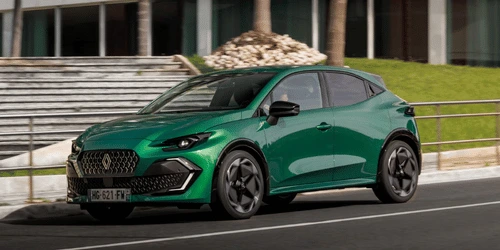
Green credentials have become closely linked with electric cars. A new Renault Clio has just given the petrol engine a useful reminder that there is still room to improve.
Green NCAP tested the latest Renault Clio TCe 115, powered by a conventional 1.2-litre petrol engine with no hybrid assistance. It returned a 3½-star Sustainability Rating and an overall score of 62%, making it one of the stronger-performing petrol superminis Green NCAP has assessed.
That does not suddenly put a petrol Clio on the same environmental footing as the cleanest electric cars. Green NCAP’s Kia EV4 test scored 90%, for example. What the Clio result does show is that vehicle weight, engine efficiency and emissions control still make a meaningful difference.
Electric car registrations are rising quickly, yet petrol and hybrid vehicles still account for a large part of the cars people actually buy. Some households cannot charge at home. Others drive in a way that suits petrol or hybrid power better. Purchase price, insurance, finance and day-to-day running costs all feed into the choice.
So, what exactly did the Clio achieve, and does it change the case for buying a petrol car in Ireland?

Why The Renault Clio Green NCAP Result Matters
Green NCAP takes a wider view than simply looking at the CO₂ figure printed on a specification sheet.
Its Sustainability Rating considers areas including exhaust emissions, energy use, and greenhouse gas emissions, as well as the environmental impact over a vehicle’s life. That allows petrol, diesel, hybrid and electric cars to be assessed using a broader set of measures.
The Clio TCe 115 achieved 6.8 out of 10 for Clean Air, 7.1 for Energy Efficiency and 4.9 for Greenhouse Gases. Green NCAP said its relatively low weight, efficient engine and effective emissions control helped it perform well compared with other petrol-only superminis.
Weight is worth paying attention to here. The tested Clio weighs 1,186kg, which is relatively light by modern-car standards. Moving less mass requires less energy, while a lighter vehicle can also reduce tyre wear and the environmental cost associated with manufacturing additional materials.
There is nothing particularly exotic about the solution. Renault has simply made a small petrol car relatively light and efficient.
Sometimes, engineering still gets to have a say.

How Fuel Efficient Is The Petrol Renault Clio?
Green NCAP recorded 5.0 litres per 100km during its on-road testing, equivalent to roughly 56mpg.
The official declared figure for the TCe 115 is 5.2 litres per 100km, with CO₂ emissions of 118g/km. Urban fuel use rose to 6.1 litres per 100km in Green NCAP’s testing, while colder conditions further increased consumption.
Those figures demonstrate why the type of driving matters as much as the powertrain badge.
A small petrol car can be very efficient on mixed and longer journeys, particularly when it is light. Stop-start urban driving places more demand on the engine, which is where full hybrids can gain an advantage by recovering braking energy and using electric assistance at lower speeds.
That distinction is useful when choosing between petrol and hybrid cars.
Someone regularly travelling longer rural routes may get good results from an efficient small petrol engine. Someone spending most of the week in Dublin, Cork or Galway traffic may find a full hybrid better suited to the job.
Our guide to whether hybrid cars are worth it in Ireland looks at how those running costs change depending on where and how you drive.
The Clio Shows Why Vehicle Weight Still Matters
Modern cars have become heavier.
Larger bodies, safety equipment, batteries, bigger wheels and additional technology all add weight. More weight usually requires more energy to move the car, whatever powers it.
The Clio’s Green NCAP result is partly a story about avoiding unnecessary mass.
Its 1,186kg kerb weight helped reduce energy consumption and tyre abrasion. Green NCAP also noted that the absence of a large traction battery reduced the energy demand associated with vehicle production.
That needs context…. Electric cars remain capable of much stronger overall Sustainability Ratings because they have no tailpipe emissions and can use energy far more efficiently. Green NCAP’s latest results gave the electric Kia EV4 five stars and 90%, well ahead of the Clio’s 62%.
The Clio result makes a narrower point: among cars that still burn petrol, design choices matter.
A lighter, more efficient supermini can have a considerably smaller environmental footprint than a larger, thirstier combustion-engine vehicle.

Petrol Cars Still Have An Environmental Limit
There is also a ceiling to what clever petrol engineering can achieve.
Every litre of petrol burned releases greenhouse gases, and Green NCAP’s scores make that visible. The Clio performed strongly for energy efficiency, while its Greenhouse Gas score was lower at 4.9 out of 10.
That is why the result should be read as evidence of lower-impact petrol motoring, rather than evidence that petrol and electric cars have become environmentally equal.
They haven’t.
The interesting question for many Irish households is more practical: if an EV does not currently fit the budget, home, driving pattern or charging situation, can choosing an efficient petrol car still reduce fuel use and emissions?
The Clio suggests the answer can be yes.

What Does This Mean For Irish Drivers?
Ireland’s new-car market is moving quickly towards electrification.
By the end of September 2026, battery-electric vehicles held 27.43% of new-car registrations, making them the largest individual powertrain category. Petrol-electric hybrids accounted for another 23.68%, while conventional petrol cars still held 19.59% of the market.
That leaves Irish drivers choosing from a much wider mix of technology than they had even a few years ago.
For some households, a battery-electric car will make the most sense. Home charging, regular mileage and lower electricity costs can make the numbers work particularly well.
Others may be better served by a hybrid, especially with plenty of urban driving.
Petrol remains relevant for drivers who want a simpler car, cover lower annual mileage or do not have convenient access to charging.
There is no single powertrain that suits every Irish driver. Your annual mileage, route, budget and access to charging should carry more weight than the badge on the boot.

There Is An Important Irish Clio Detail
The car tested by Green NCAP was the latest-generation Clio TCe 115 petrol, which uses Renault’s new 1.2-litre turbocharged engine.
Renault developed the sixth-generation Clio with several powertrain options for European markets, including the TCe 115 petrol engine and a more powerful full-hybrid system.
At the time of writing, Renault Ireland currently lists the Clio E-Tech full hybrid rather than the TCe 115 petrol model tested by Green NCAP. The Irish-market Clio starts from €29,495 and Renault quotes fuel consumption from 4.1 litres per 100km with CO₂ emissions from 93g/km.
That distinction is worth making because the Green NCAP result tells us something broader about modern petrol technology rather than acting as a direct review of the Clio currently sitting in Irish Renault showrooms.
The Irish Clio hybrid goes further on fuel economy by adding electric assistance.
Petrol Or Hybrid: Which Makes More Sense In Ireland?
There is a natural comparison here.
A conventional petrol car generally has a simpler drivetrain and may cost less than an equivalent hybrid in markets where both versions are offered. A full hybrid adds a battery and electric motor, allowing the engine to switch off more often and recover energy during braking.
That gives hybrids a particular advantage in stop-start driving.
Renault says the current Irish Clio E-Tech can complete up to 80% of urban driving time using electric power under its internal test conditions. Its official fuel consumption starts at 4.1 litres per 100km, compared with the 5.2 litres per 100km declared for the petrol TCe 115 tested by Green NCAP.
The difference may matter a lot to a high-mileage urban driver. For someone covering relatively few kilometres each year, the fuel saving needs to be considered alongside purchase price and the cost of changing car.
If you’re weighing up the two, our guide to the best hybrid cars for Irish drivers covers some of the models currently worth considering.

Running Costs Matter More Than Fuel Economy Alone
A good litres-per-100km figure gets plenty of attention, but it only covers one part of the cost of owning a car.
Insurance can vary dramatically between models and drivers. Motor tax depends on CO₂ emissions. Servicing, tyres, depreciation and finance repayments can easily outweigh a small difference in fuel consumption.
That is particularly important when working to a fixed monthly budget.
A newer hybrid may save money at the pump while costing more to buy. An efficient used petrol car may use slightly more fuel but come with a much lower purchase price. Depending on annual mileage, the cheaper car can still cost less overall.
When choosing a car, it helps to work backwards from the full monthly budget rather than starting with the engine type.
Our guide to buying a used car in Ireland covers the wider checks to make, including history, condition, NCT status and the ongoing costs that sit beyond the purchase price.
Efficient Petrol Cars Could Matter More In The Used Market
New-car technology eventually becomes a used-car choice.
That matters because many Irish households will experience the transition towards lower-emission cars through the used market rather than by buying a brand-new EV.
Ireland also continues to import significant numbers of used cars. By September 2026, imported used-car registrations were up 34.4% compared with the same period in 2025.
As newer, more efficient petrol and hybrid cars enter the second-hand market, buyers should have more choice among lower-cost vehicles across different price points.
A five-year-old efficient petrol hatchback may suit someone very differently from a nearly-new EV or hybrid. Condition, mileage, purchase price, and how the car will actually be used all need to be included in the same calculation.
For people shopping at the lower end of the market, our guide to the best cars under €5,000 in Ireland also shows why smaller petrol cars continue to feature heavily among affordable used options.
Does A Green NCAP Rating Mean A Car Is Cheap To Run?
Not automatically.
Green NCAP measures environmental performance rather than your household budget.
The two can overlap because an energy-efficient car usually consumes less fuel, but purchase price, insurance, tax and maintenance still matter.
The Clio’s 5.0 litres per 100km result gives a useful indication that the petrol engine can use fuel efficiently in real-world conditions. It cannot tell you whether a particular Clio will be cheaper to own than a hybrid, EV or used alternative.
For that, you need to look at your own mileage.
If one car saves one litre of petrol every 100km, someone driving 25,000km per year will feel the difference much more than someone travelling 5,000km.
Efficiency works best when the sums are personal.
Are Petrol Cars Still Worth Buying In Ireland?
For some drivers, yes.
The Irish new-car market is moving towards electric and hybrid power, and that shift is likely to continue. Petrol cars still make up a meaningful share of registrations, while the used market contains a much larger number of petrol models across a wide range of budgets.
An efficient petrol car can still make practical sense where annual mileage is modest, charging is difficult or the purchase budget rules out suitable electric alternatives.
The Clio’s Green NCAP result adds another consideration. Modern petrol cars can vary considerably in environmental performance, and smaller, lighter models with efficient engines can reduce fuel use and emissions compared with heavier or less efficient combustion cars.
That makes it worth looking beyond a simple petrol-versus-electric label.
Look at the actual car.

How LMO Looks At The Bigger Affordability Picture
Fuel efficiency matters because the monthly finance payment is only one part of running a car.
LMO provides Hire Purchase finance for petrol and hybrid vehicles in Ireland, including for customers whose circumstances may fall outside the criteria used by mainstream lenders.
We use human underwriting, which means an application receives individual consideration rather than relying only on an automated credit decision. Affordability still comes first, and choosing a car with manageable fuel, tax and ownership costs forms part of that wider financial picture.
If you have had difficulty finding car finance elsewhere, our guide to how human underwriting works in Irish car finance explains why different lenders can reach different decisions on the same customer.
What The Renault Clio Result Really Tells Us
The Renault Clio has not rewritten the environmental rulebook.
It has shown what can happen when a conventional petrol car stays relatively light, uses fuel carefully and controls its emissions well.
Green NCAP’s 62% result sits well below the best electric cars, while still placing the Clio among the stronger petrol superminis it has assessed.
That feels relevant to Ireland because the move towards lower-emission motoring will happen at different speeds for different people.
Some drivers are ready for electric now. Plenty are choosing hybrids. Others will continue using petrol cars for years.
Better petrol cars still matter while that transition happens.
And if petrol suits your circumstances, choosing an efficient one makes considerably more sense than simply assuming every petrol engine performs the same.

Ready To Find A Car That Fits Your Budget?
Choosing between petrol and hybrid comes down to more than fuel economy. The right car also needs to fit comfortably within your wider monthly budget.
LMO provides Hire Purchase finance for qualifying petrol and hybrid cars in Ireland, with every application reviewed by an experienced underwriter. We look at your individual circumstances and affordability, rather than relying only on an automated credit decision.
If you’re planning your next car, apply for car finance with LMO and see what options may be available to you.
Renault Clio And Petrol Car FAQs
What Green NCAP Rating Did The Renault Clio Get?
The Renault Clio TCe 115 achieved a 3½-star Green NCAP Sustainability Rating with an overall score of 62%. It scored particularly well for energy efficiency compared with other conventional petrol superminis.
How Fuel Efficient Is The Renault Clio TCe 115?
Green NCAP recorded 5.0 litres per 100km during its on-road test. Renault’s declared figure is 5.2 litres per 100km.
Is The Renault Clio TCe 115 Available In Ireland?
Renault Ireland currently lists the Clio E-Tech full hybrid on its Irish website. The TCe 115 assessed by Green NCAP is part of the latest European Clio range, so Irish availability should be checked with Renault.
How Economical Is The Renault Clio Hybrid In Ireland?
Renault Ireland quotes fuel consumption from 4.1 litres per 100km and CO₂ emissions from 93g/km for the Clio E-Tech full hybrid.
Are Petrol Cars Still Worth Buying In Ireland In 2026?
They can be. Petrol may suit drivers with lower annual mileage, limited access to charging or a tighter purchase budget. The best choice depends on the individual vehicle, mileage, running costs and how it will be used.
Is A Hybrid Cheaper To Run Than A Petrol Car?
A full hybrid will often use less fuel in urban and stop-start driving because it can recover braking energy and use electric assistance. The overall cost also depends on purchase price, insurance, tax, maintenance and annual mileage.
Can I Finance A Petrol Or Hybrid Car With LMO?
Yes. LMO provides Hire Purchase finance for qualifying petrol and hybrid vehicles in Ireland and specialises in non-prime lending with human underwriting.
If your credit history has made car finance difficult elsewhere, LMO can take a closer look at your circumstances and help you understand the options available. Apply now!